

Cities across the U.S. increasingly face air quality challenges—from asthma-prone neighborhoods to wildfire haze warning systems. Traditional monitoring systems rely on sparse, fixed-location sensors that offer incomplete coverage. New technology brings air quality sensors to the most-used urban infrastructure—bus stops—transforming them into localized, real‑time air monitors.

The Problem: Insufficient Monitoring Data
Many U.S. communities suffer from “air quality monitoring deserts,” where official monitoring stations are sparse or far apart. In New York’s Hudson Valley, for example, residents lacked local data until nonprofit and academic groups deployed rooftop sensors across multiple towns to provide meaningful hyperlocal readings—and public alerts. Without this, people could not accurately assess exposure risks in their own neighborhoods Wikipedia+6jcdecauxna.com+6arXiv+6Times Union.
In major cities facing wildfires, like Los Angeles, residents encounter conflicting air quality data across apps due to inconsistent interpretations. Even when multiple data sources exist, ambiguity undermines public trust and health protection WIRED. Without real-time, localized insights, cities remain reactive—not preventive.
The Solution: Bus Stop–Mounted Air Sensors
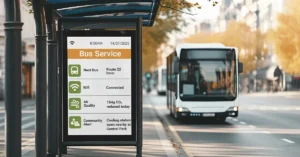
Across the country, pilot programs are turning bus shelters into live air quality stations. In Chicago, 100 bus shelters have been fitted with sensors that continuously monitor pollutants like PM₂.₅, NO₂, and humidity. Data is accessible to the public via QR code or the city’s open data portal, offering transparency and action-ready insights govlaunch.com+1jcdecauxna.com+1.
Elsewhere, taxi and bus fleets equipped with mobile sensors have proven capable of delivering street-by-street pollution data. A study tracking over 100 million PM₂.₅ readings from taxis in six U.S. cities demonstrated how mobile networks can expose local pollution hotspots and temporal patterns missed by stationary monitors PCA Minnesota+4arXiv+4arXiv+4. When mounted in transit infrastructure, these sensors amplify the reach of air quality networks.
The Benefits of On-Site, Real-Time Monitoring
Enhanced Coverage
Bus-stop sensors fill critical gaps in traditional monitor networks. Cities like Minneapolis have used such systems to create neighborhood-specific data that informs public health alerts, urban planning decisions, and equitable environmental policy PCA Minnesota+4PCA Minnesota+4Reddit+4.
Public Engagement and Transparency
With QR-coded public dashboards, riders and residents can see real-time air quality stats for their immediate surroundings. This fosters accountability—and encourages behavior change by making data visible and actionable .
The Role of Technology Platforms Like Varidx
While deploying sensors is important, integrating and analyzing the incoming data is equally critical. Platforms like Varidx provide modular analytics and visualization tools tailored for transit-based environmental monitoring. They enable agencies to combine mobile and fixed-location sensor readings into unified air quality maps, historical trend reports, and public alert dashboards—without reinventing the system from scratch.
By removing integration barriers, Varidx helps cities deploy bus‑stop and vehicle-based air monitoring as scalable, data-rich systems—all with less complexity and more focus on local impact. https://varidx.io/
Final Word
Real-time, mobile air quality monitoring opens up a powerful opportunity: to protect communities before they face poor air exposure. By embedding sensing systems at bus stops and on transit vehicles, cities can fill data gaps, empower residents, and guide smarter public health decisions. As Maureen Steigenberger, Director of Urban Data Systems, notes: “you can’t manage what you don’t measure—let alone predict.”
With smart data insights at every stop, our transit networks can become tools for both mobility and clean air.