

For many cities, park lighting is still treated as a basic utility. Lights go on at dusk, turn off at dawn, and get fixed when something breaks. But as public expectations rise and operational pressures increase, this approach is starting to show its limits.
Parks today are more than green spaces. They are community hubs, fitness zones, event venues, and critical public assets that need to feel safe, welcoming, and well managed. Lighting plays a central role in all of this, not just as illumination, but as an operational signal.
The shift happening in many cities is subtle but important. Smart lighting is no longer about brighter lamps or stylish fixtures. It’s about visibility, responsiveness, and control.
Why lighting matters beyond safety
A well-lit park feels safer. That’s well understood. But the real operational value of lighting lies in what it reveals about how spaces are used.
Lighting patterns influence when people visit, which paths they choose, and how long they stay. Poorly lit areas tend to be avoided, while well-lit zones attract more activity. When cities can see these patterns in near real time, they gain insight into how public spaces actually function after dark.
This matters for more than perception. Increased usage often brings maintenance needs, staffing considerations, and safety planning into sharper focus. Without connected visibility, cities are forced to rely on assumptions or delayed reports. With integrated systems, early signals become actionable.
Moving from fixed schedules to adaptive systems
Traditional park lighting runs on fixed schedules. The same brightness, the same timing, regardless of weather, usage, or special events. This often leads to wasted energy in low-use areas and insufficient lighting in high-traffic zones.
Smart lighting changes that model. Systems can adjust brightness based on movement, ambient conditions, or operational priorities. During a community event, lighting can increase where needed. Late at night, it can scale back where activity is low, without compromising safety.
Platforms like Varidx support this shift by helping cities manage lighting behavior as part of broader park operations — not as a standalone control system, but as one input among many that inform daily decisions.
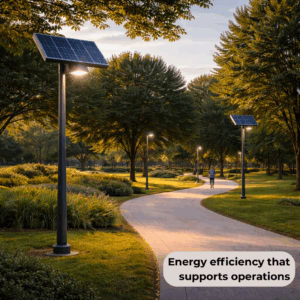
Energy efficiency that supports operations, not just budgets
Energy efficiency is often the headline benefit of smart lighting, and rightly so. LED and solar-powered systems significantly reduce energy consumption and long-term costs.
But for city teams, the operational impact is just as important. Lower energy use reduces strain on infrastructure. Predictable performance simplifies planning. Fewer outages mean fewer service calls and less reactive maintenance.
When lighting data is connected with other operational information — usage, maintenance history, incident reports — cities can plan upgrades and sustainability initiatives with greater confidence. This kind of integrated view is where platforms like Varidx add value, by bringing fragmented data into one operational picture.
Lighting as part of a connected parks ecosystem
One of the most common challenges parks and recreation teams face is working across disconnected systems. Lighting, safety, maintenance, and usage data often live in separate tools, making coordination harder than it needs to be.
Lighting becomes far more powerful when it’s treated as part of a connected ecosystem. Patterns in lighting usage can help identify areas of high foot traffic, inform staffing decisions, and support safety planning. Over time, this data can also help justify budgets and guide future investments.
Rather than adding more dashboards, cities benefit from fewer, clearer operational views. Varidx is designed around this idea — helping teams see what’s happening across systems without adding complexity to their workflows.
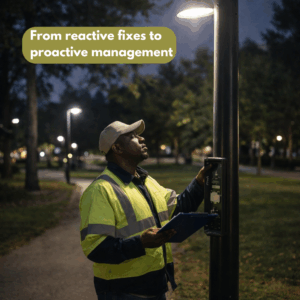
From reactive fixes to proactive management
Many lighting issues today are addressed only after a complaint is logged or a failure becomes visible. This reactive model costs time, money, and public trust.
Connected lighting systems make it possible to spot issues earlier. A fixture drawing abnormal power, a sudden drop in nighttime activity, or repeated adjustments in the same zone can all signal underlying problems before they escalate.
With the right operational intelligence in place, teams can intervene sooner, coordinate responses across departments, and avoid turning small issues into public-facing disruptions.
Designing for people, not complexity
For parks and recreation leaders, technology adoption succeeds only when it makes daily work easier. Smart lighting systems must be intuitive, transparent, and aligned with how teams actually operate on the ground.
The goal isn’t to replace human judgment. It’s to support it — by reducing blind spots, improving awareness, and enabling faster coordination. Varidx approaches lighting as one piece of a broader operational puzzle, helping cities move from reactive responses to proactive management.
Looking ahead
As cities continue to invest in public spaces, lighting will remain one of the most visible elements of park design. But its real impact lies in how well it supports operations behind the scenes.
Smart lighting, when integrated into connected city platforms, helps parks teams see more clearly, respond faster, and manage spaces with greater confidence.
The future of parks isn’t just brighter. It’s more connected, more adaptive, and better aligned with how communities actually use public spaces. And lighting — supported by the right operational intelligence — is a practical step in that direction.