
Cities today are not short on data.
They see traffic building up before it becomes gridlock. They know which neighborhoods flood first. They track air quality dips, power usage spikes, and public transport delays in near real time.
Yet, despite seeing the problem early, action often comes late.
This is the quiet struggle many cities face. Not ignorance. Not lack of intent. But a gap between insight and action that slows everything down.
The Real Bottleneck Isn’t Visibility. It’s Coordination.
Most modern cities already have sensors, dashboards, and monitoring systems. Traffic departments have their own feeds. Water authorities track levels and flow. Emergency teams rely on separate command systems. Urban planners work with historical data. Operations teams focus on today’s fires.
Each department does its job well.
But they do it in isolation.
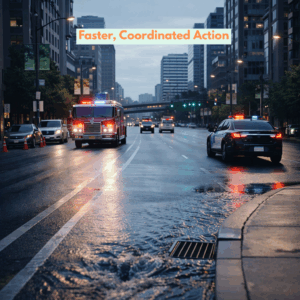
When data stays trapped within departments, insight loses its power. A traffic spike detected early means little if enforcement, signaling, and public communication are not aligned. A flood warning loses value if drainage teams, emergency responders, and civic authorities act on different timelines.
The city sees the problem.
But the city cannot move as one.
Why Insight Alone Doesn’t Change Outcomes
Cities don’t fail because they lack intelligence. They struggle because action requires agreement, authority, and coordination across multiple stakeholders.
Here’s what often happens:
- One department detects an issue
- Another department owns the response
- A third controls the resources
- A fourth manages public communication
Each step introduces delay.
By the time decisions travel across silos, the moment for early intervention is gone. What could have been a small adjustment turns into a full-scale disruption.
This is why citizens feel the disconnect. From their point of view, the city “knew” something was wrong. So why did nothing happen sooner?
Stuck, Not Behind
It’s easy to say cities are lagging. That’s not accurate.
Most cities are stuck between growing complexity and outdated operating models. Urban systems are now deeply interconnected, but decision-making structures remain fragmented. Data moves faster than authority. Technology advances faster than process.
The result is a city that can observe problems in high resolution but respond in slow motion.
This isn’t a technology failure.
It’s a systems problem.
Turning Insight into Action Requires a Bridge
For cities to move faster, they don’t need more dashboards. They need bridges.
Bridges between departments, so data doesn’t stop at organizational boundaries.
Bridges between systems, so signals trigger workflows instead of alerts alone.
Bridges between insight and authority, so decisions don’t wait for manual escalation.
This is where platforms like Varidx play a critical role. (https://varidx.io/)
Instead of treating monitoring, analysis, and response as separate layers, Varidx connects them into a single operational flow. Signals from the field are not just visualized, they are contextualized, shared, and translated into action pathways.
From Seeing to Doing
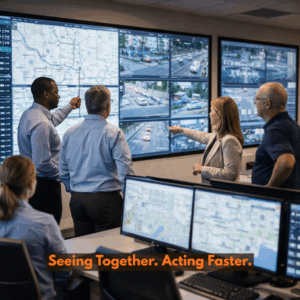
When departments work from a shared operational picture, responses change.
Traffic data can automatically inform signal optimization, enforcement readiness, and commuter advisories. Flood alerts can trigger coordinated drainage actions, emergency preparedness, and public warnings without manual handoffs. Air quality data can guide traffic restrictions, industrial controls, and health advisories in sync.
The difference is subtle but powerful.
The city no longer asks, “Who should act?”
The city already knows.
Why This Matters More Than Ever
Urban challenges are becoming faster and less predictable. Climate events escalate quickly. Mobility patterns shift daily. Infrastructure is under constant stress. In this environment, delayed action is not a minor inefficiency. It’s a risk.
Citizens judge cities not by how much data they collect, but by how effectively they respond. A city that reacts early builds trust. A city that reacts late invites frustration.
The future of smart cities will not be defined by how smart their sensors are. It will be defined by how seamlessly insight turns into response.
The City as One System
When cities operate as connected systems rather than disconnected departments, something important happens. Problems shrink before they grow. Resources are used more efficiently. Teams stop working around each other and start working with each other.
This is the shift Varidx focuses on enabling. Not just smarter visibility, but smarter action. Not just knowing what’s happening, but knowing what to do next and doing it together.
Because in modern cities, the gap between insight and action is where progress either accelerates or stalls.
And closing that gap is what truly makes a city smart.