

Cities today generate more operational data than ever before. Sensors track traffic flow. Infrastructure systems monitor performance. Emergency services record response times. Environmental networks measure air quality and weather conditions.
But despite all this data, many city teams still face the same daily question:
How do we turn all this information into faster, clearer decisions?
For municipal teams responsible for infrastructure, mobility, and public services, the challenge is rarely a lack of data. The real challenge is making sense of it when time is limited and situations are evolving quickly. (https://www.nist.gov/programs-projects/global-community-technology-challenge)
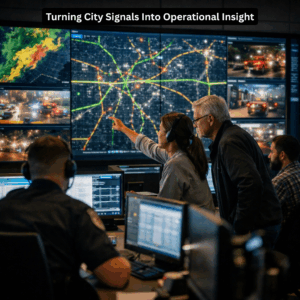
The Missing Link: Context
Data alone does not solve operational problems.
What cities truly need is context.
For example:
A spike in traffic sensors may indicate congestion.
But if weather data, public events, and road construction are also considered, the situation becomes clearer.
Similarly:
A flood sensor alert is useful.
But combining it with rainfall forecasts, drainage capacity, and historical flood patterns reveals whether the situation is routine or critical.
When systems begin to connect these signals, cities move closer to anticipating problems instead of simply reacting to them.
From Monitoring Systems to Decision Support
Municipal technology has traditionally focused on monitoring.
Dashboards display conditions.
Alerts notify teams when thresholds are crossed.
But the next step is emerging: decision support systems.
Instead of simply presenting data, these systems help interpret it.
Imagine a city operations platform that can:
- Identify patterns across infrastructure systems
• Highlight operational risks earlier
• Recommend possible responses based on past conditions
• Help teams prioritize actions across departments
In other words, technology that doesn’t just show what’s happening — but helps teams understand what to do next. (https://www.mckinsey.com/industries/public-sector/our-insights/smart-cities-digital-solutions)
The Reality of Daily City Operations
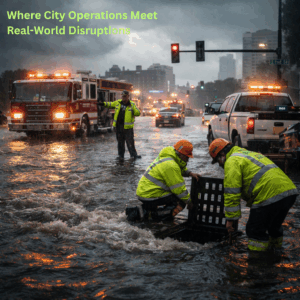
City operations rarely unfold in a predictable way.
A storm arrives earlier than expected.
Traffic congestion spreads across multiple corridors.
A water main failure disrupts surrounding neighborhoods.
Emergency responders are stretched across multiple incidents.
In these moments, city teams rely on experience, coordination, and fragmented information across multiple systems.
Even with modern technology, many departments still work across separate dashboards, disconnected data streams, and manual analysis.
The result?
Decisions often rely on partial information when what cities really need is clear operational insight in real time. (https://www.gartner.com/en/documents/3986287)
Why This Matters for Cities Now
Urban environments are becoming more complex.
Population growth, climate pressures, aging infrastructure, and increasing service expectations are all placing new demands on municipal teams.
Cities are expected to respond faster, coordinate better, and anticipate disruptions earlier than ever before.
AI is beginning to offer new ways to support these expectations — not by replacing city expertise, but by helping teams interpret large amounts of operational data more quickly.
For city leaders, operations managers, and technology teams, the question is becoming increasingly relevant:
What insights might emerge if city data could actively guide operational decisions?
Exploring the Idea of a City AI Advisor
One emerging concept gaining attention is the idea of a City AI Advisor.
Rather than acting as another dashboard, the goal is to create a system that can interpret multiple data streams and help cities explore possible responses to operational challenges.
For example, a city team might ask:
What actions should we consider if severe rainfall is expected within the next six hours?
Which intersections are most likely to experience congestion during a major event?
How might different response strategies affect emergency service coverage?
By combining real-time data, historical patterns, and operational context, AI systems can begin to support decision-making in ways traditional dashboards cannot.
The technology is still evolving, but the potential for cities is significant.
A Conversation Cities Are Starting to Have
Across the United States, municipal leaders are beginning to explore how AI might support city operations in practical ways.
Not as a futuristic concept, but as a tool that helps teams make better use of the data they already collect.
Questions are emerging such as:
- How can AI help interpret infrastructure signals faster?
• Can operational risks be identified earlier?
• How can cities improve coordination across departments?
• What would AI suggest when faced with complex operational challenges?
These are not theoretical discussions anymore. They are becoming part of the real conversation about the future of city operations.
Bringing the Conversation to Smart Cities Connect
These ideas will be explored further at Smart Cities Connect, where city leaders, technologists, and infrastructure experts gather to discuss the future of urban innovation.
At the event, Varidx will be introducing the concept of the City AI Advisor — an approach designed to help municipalities explore how AI could support operational decision-making.
City teams attending the conference are invited to bring one simple question:
What is the biggest operational challenge your city expects to face in 2026?
From infrastructure disruptions to mobility issues and emergency coordination, the discussion will focus on how AI might help cities analyze complex situations and explore possible responses.
If you’re attending Smart Cities Connect, we invite you to learn more and see how the concept works.
Visit the event page to explore the City AI Advisor 👉 Varidx at Smart Cities Connect Conference & Expo 2026