

City leaders today operate in an environment of increasing complexity. Infrastructure networks are aging, populations are growing, and climate-related disruptions are becoming more frequent. At the same time, municipal departments are expected to respond faster, coordinate better, and deliver reliable services across transportation, utilities, and public safety systems.
The challenge is not simply about technology adoption. Cities already generate enormous volumes of operational data through sensors, monitoring systems, and connected infrastructure. The real question facing municipal teams is how to transform that information into timely operational decisions.
Across the public sector, a new concept is beginning to emerge: AI advisors designed specifically for municipal operations.

A New Type of Decision Support for Cities
In many industries, professionals now work alongside AI copilots that assist with analysis, recommendations, and scenario planning. Businesses use these tools to interpret large datasets and guide operational decisions more quickly.
A similar idea is beginning to take shape for cities.
Instead of simply presenting data on dashboards, an AI advisor for city operations can analyze information from multiple sources — transportation systems, weather networks, infrastructure sensors, and emergency services — to highlight patterns and recommend possible responses.
For example, an operations team might ask:
- How will severe rainfall affect flood-prone neighborhoods in the next six hours?
- Which traffic corridors are likely to experience congestion during a large public event?
- What operational adjustments could improve emergency response coverage during peak hours?
By analyzing historical patterns alongside real-time data, AI systems can help municipal teams explore potential responses faster and more confidently. This approach transforms technology from a monitoring tool into a decision-support partner. (https://www.mckinsey.com/industries/public-sector/our-insights/smart-cities-digital-solutions)
Why Municipal Operations Are Becoming More Data-Intensive
Modern city infrastructure produces continuous streams of operational information. Traffic sensors measure vehicle flow. Water networks monitor pressure and leakage. Environmental systems track air quality and rainfall levels.
These datasets are valuable, but they often remain distributed across separate departments and platforms. Transportation teams, utilities, emergency services, and environmental agencies may all rely on different systems to track conditions in the city.
Without a unified way to interpret these signals, important insights can remain hidden in isolated data streams.
This is why many municipal leaders are now focusing on operational intelligence — the ability to connect multiple data sources and identify patterns that help guide decisions. Research from the National Institute of Standards and Technology (NIST) highlights how integrated data platforms are becoming critical for modern smart city initiatives. (https://www.nist.gov/programs-projects/global-community-technology-challenge)
Improving Operations Without Increasing Budgets
One of the most pressing challenges facing city governments is financial. Municipal budgets are often constrained, yet service expectations continue to grow.
City leaders must maintain infrastructure, respond to emergencies, and deliver reliable public services — often with limited resources and staffing.
This is where AI and connected infrastructure can play an important role.
By analyzing operational data across systems, cities can identify opportunities to improve efficiency without expanding budgets. Predictive insights can help prioritize maintenance before failures occur, reducing costly emergency repairs. Traffic optimization strategies can reduce congestion and improve mobility without new infrastructure investments.
Similarly, real-time infrastructure monitoring can allow departments to allocate personnel more effectively during incidents.
In this way, AI-supported operational tools can help cities achieve more with the resources they already have — a priority that many municipal leaders now consider essential for sustainable urban management. (https://www.weforum.org/reports/shaping-the-future-of-cities)
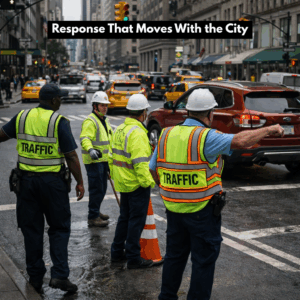
From Data Dashboards to Operational Insight
Traditional city technology platforms focus heavily on dashboards. These systems display data from various infrastructure networks, allowing operators to monitor conditions across the city.
While dashboards provide visibility, they do not always answer the most important operational question: What should we do next?
AI-powered advisory systems attempt to address this gap.
By combining historical data, real-time signals, and predictive models, these systems can help identify risks earlier and present possible response strategies. Rather than replacing human decision-makers, the goal is to support municipal expertise with deeper data interpretation.
For city leaders responsible for transportation systems, utilities, and emergency coordination, this type of capability can significantly improve situational awareness and operational planning.
Supporting the Next Generation of City Operations
As cities continue to adopt connected infrastructure and IoT-based monitoring systems, the ability to interpret operational data quickly will become increasingly important.
Varidx is exploring this opportunity through the concept of the City AI Advisor — a system designed to help municipal teams interpret complex operational signals and explore potential responses across infrastructure systems. (https://app.varidx.io/cityai/)
By combining IoT data streams, historical infrastructure insights, and AI-driven analysis, such platforms can help cities move toward more proactive operations.
For municipal leaders managing transportation networks, environmental monitoring systems, and critical infrastructure, the goal is simple: turn city data into practical operational guidance that helps teams respond faster and plan smarter.