

Park and recreation leaders rarely operate in the spotlight, yet their work shapes some of the most visible and valued spaces in a community. Parks are where cities slow down, where families gather, where health, safety, and quality of life quietly intersect. Behind these spaces is a role that demands constant coordination, practical decision-making, and the ability to balance expectations that often compete with each other.
The challenge is not just maintaining parks. It is managing systems, people, resources, and public expectations all at once.

The Weight of Everyday Operations
A park may appear calm and self-sustaining from the outside, but daily operations are anything but simple. Leaders are responsible for maintenance schedules, cleanliness, equipment safety, landscaping, and visitor experience across multiple locations.
What makes this complex is not any single task, but the accumulation of them. A maintenance delay in one park can affect visitor satisfaction. A broken light in another can raise safety concerns. A missed inspection can lead to larger operational issues.
These responsibilities do not arrive one at a time. They overlap. They compete for attention. And they often require decisions to be made with incomplete information.
Balancing Safety and Accessibility
Parks are meant to be open, inclusive, and accessible. At the same time, they must be safe. This balance is not always easy to maintain.
Leaders must think about lighting, surveillance, equipment safety, and crowd management, all while ensuring that parks remain welcoming spaces. Too much restriction can reduce accessibility. Too little oversight can create risk.
The challenge lies in making decisions that protect visitors without changing the nature of the space itself. Safety in parks is not just about control. It is about awareness, timing, and response. According to the National Recreation and Park Association, ensuring safe and accessible parks remains a top priority for departments across the U.S.
Managing Limited Resources
Most park and recreation departments operate within tight budgets. Resources must stretch across maintenance, staffing, programming, and infrastructure upgrades.
Leaders are often required to prioritize. Should funds go toward repairing aging equipment or improving visitor amenities? Should staffing focus on high-traffic areas or be distributed evenly?
These are not purely financial decisions. They directly affect how citizens experience public spaces. Doing more with less is not a temporary situation. It is an ongoing reality, as highlighted by the Urban Land Institute, which notes that cities are expected to improve public spaces without proportional budget increases.
Responding to Changing Usage Patterns
How people use parks has evolved. Parks are no longer just green spaces. They are fitness zones, event venues, community gathering points, and sometimes even workspaces.
This shift brings unpredictability. Visitor numbers can change based on time of day, season, or local events. Certain areas may become overcrowded while others remain underutilized.
Leaders must adapt to these patterns without always having clear visibility into them. Planning becomes reactive when usage is not fully understood. Research from the Trust for Public Land shows that park usage trends have shifted significantly, increasing the need for adaptive management strategies.
Coordinating Across Departments
Parks do not operate in isolation. They connect with other city functions such as public safety, sanitation, transportation, and environmental services.
A large public event in a park may require coordination with traffic management. A maintenance issue may involve public works. A safety concern may require law enforcement.
The challenge is not just communication, but alignment. Different departments operate on different systems, timelines, and priorities. Bringing them together during critical moments requires clarity and coordination that is not always easy to achieve.
The Pressure of Public Expectations
Parks are one of the most visible indicators of how well a city is functioning. When they are clean, safe, and well-maintained, citizens notice. When they are not, the response is immediate.
Park and recreation leaders operate under constant public visibility. Feedback comes quickly, often through multiple channels. Expectations continue to rise, even when resources remain limited.
This creates a unique pressure. Decisions must not only be operationally sound but also publicly defensible.
Making Decisions Without Complete Visibility
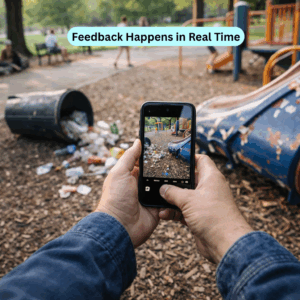
One of the less visible challenges is the lack of real-time insight. Leaders often rely on periodic reports, manual checks, or citizen feedback to understand what is happening across parks.
This creates gaps. Issues may be identified after they have already escalated. Opportunities for optimization may be missed.
The result is a constant need to make decisions without having the full picture. And in operational roles, timing is often as important as the decision itself.
Moving Toward More Informed Operations
As cities explore smarter infrastructure, park operations are beginning to shift as well. The focus is gradually moving from reactive management to more informed, proactive decision-making.
This is where Varidx can play a meaningful role. By connecting data across parks, visitor patterns, environmental conditions, and maintenance workflows, leaders can gain clearer visibility into what is happening in real time.
More importantly, this visibility can be tied to action. Instead of waiting for issues to surface, teams can anticipate them. Instead of spreading resources evenly, they can allocate them where they are needed most.
Explore how integrated systems support smarter city operations: https://varidx.io/
For park and recreation leaders, the goal is not to add complexity. It is to reduce uncertainty. To move from guesswork to clarity.
Because in the end, their role is not just about managing spaces. It is about shaping experiences, ensuring safety, and maintaining trust in the everyday places that communities rely on the most.