
Across the United States, city leaders are being asked to deliver better services, faster responses, and more transparency without a corresponding increase in budgets. Rising operational costs, aging infrastructure, and growing populations are stretching municipal resources thin. In this environment, the question is no longer how to spend more, but how to operate smarter.
The answer increasingly lies in the strategic use of AI and IoT technologies that allow cities to extract more value from existing systems, rather than investing heavily in new ones.
The Challenge: More Expectations, Same Resources
Municipal departments today are under constant pressure. Public safety teams must respond faster. Public works must maintain aging assets. Transit systems must handle fluctuating demand. At the same time, budget approvals are slower and often constrained by policy and economic conditions.
According to the National League of Cities, many cities report that operational efficiency is now a top priority, especially as federal funding cycles fluctuate and long-term infrastructure needs continue to grow.
The challenge is not a lack of data. Cities already generate vast amounts of it. The real issue is turning that data into coordinated action.
Where Efficiency Is Lost
In most cities, departments operate in silos. Transportation, utilities, emergency services, and environmental monitoring often use separate systems that do not communicate with each other.
This creates three key inefficiencies:
- Delayed decision-making: Data exists, but it is not unified or contextualized
- Resource misallocation: Teams respond reactively instead of proactively
- Operational overlap: Multiple departments address the same issue without coordination
Research from the Urban Land Institute highlights that fragmented systems are one of the biggest barriers to improving city performance without increasing costs.
The Role of AI and IoT in Smarter Operations
AI and IoT do not replace infrastructure they enhance it. By connecting existing assets and layering intelligence on top, cities can unlock efficiencies that were previously hidden.
IoT devices collect real-time data from across the city: traffic flow, air quality, water levels, energy usage, and more. AI then processes this data to identify patterns, predict issues, and recommend actions.
For example:
- Traffic management: Adjusting signal timings dynamically based on congestion patterns
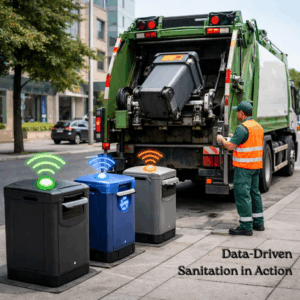
- Waste management: Optimizing collection routes based on fill-level sensors
- Energy usage: Monitoring and reducing consumption in public buildings
- Public safety: Identifying risk patterns and improving response coordination
The McKinsey & Company notes that smart city technologies can reduce operational costs by up to 20–30% in certain functions by improving efficiency and reducing waste.
From Visibility to Action
Many cities have already invested in dashboards and monitoring tools. However, visibility alone does not drive results.
The real shift happens when cities move from seeing data to acting on it in real time.
This requires:
- Centralized platforms that bring multiple data streams together
- Cross-department coordination so teams can act on shared insights
- Automated workflows that reduce manual intervention
This is where Varidx becomes relevant. By enabling cities to unify data from multiple systems and convert it into actionable workflows, Varidx helps bridge the gap between visibility and execution without requiring a complete infrastructure overhaul.
Practical Steps Cities Can Take
Improving operations without increasing budgets does not require a complete transformation. Cities can start small and scale strategically.
- Connect existing systems first instead of replacing them
- Prioritize high-impact use cases like traffic, utilities, or emergency response
- Use pilot projects to demonstrate ROI before expanding
- Focus on interoperability to ensure long-term scalability
Organizations like the Smart Cities Council emphasize that incremental adoption often leads to faster results and lower risk compared to large-scale transformations.
A Smarter Way Forward
For city leaders, the goal is not just to manage resources but to maximize their impact. AI and IoT provide a pathway to do exactly that by turning disconnected data into coordinated action.
With platforms like Varidx, cities can move beyond passive monitoring and take control of operations in real time improving efficiency, reducing waste, and delivering better outcomes without increasing budgets.
Because in today’s urban environment, doing more with less is not a constraint, it’s a capability.