

As U.S. cities adopt next-gen transit tech, many early deployments falter—not because the vision is flawed, but because rigid, monolithic systems can’t keep up. Instead, modular, phased investments are emerging as the smarter, more resilient approach. These adaptable solutions help transit agencies reduce risk, implement upgrades over time, and match funding with proven results.

By spotlighting recent pilot programs, federal initiatives, and agile design strategies, this article explains why modularity is becoming essential—and how U.S. transit agencies can successfully implement it.
The Challenge of High Upfront Costs and Rapidly Changing Technology
Transit agencies must invest heavily to install the latest tech—sensor networks at stations, AI-powered scheduling software, and vehicle automation platforms. According to the FTA’s STAR Plan 2.0, high capital requirements and rapid tech obsolescence have made agencies “hesitant to deploy” automation without clarity on long-term returns. (FTA STAR Plan 2.0).
Moreover, peripheral technologies—like AI, V2X communication, and autonomous shuttles—are evolving rapidly. A 2025 study confirms that R&D in transit automation remains nascent, exposing early projects to costly retrofits or full system replacements in just a few years. Agencies without flexible technology architectures risk financial penalties and wasted investments.
The Solution Lies in Scalable, Modular Platforms with Phased Rollouts
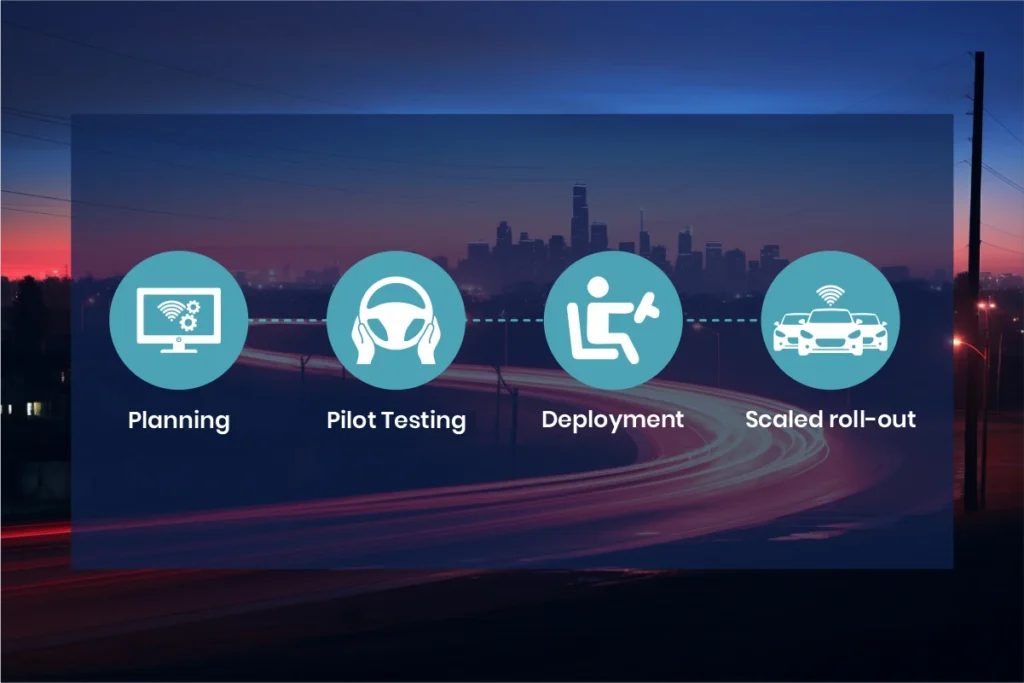
A growing number of U.S. agencies are adopting modular platforms deployed in structured phases. The USDOT’s ITS4US Deployment program, for instance, ties funding to clearly defined stages: planning, pilot testing, deployment, and scaled roll-out (ITS4US Deployment Program). This ensures each stage is validated before further capital is committed
A standout pilot—Atlanta’s “MARTA Reach”—used this approach to integrate tech-driven microtransits alongside core bus routes, improving first- and last-mile access based on real rider data (MARTA Reach Pilot). Results from the ITS Deployment Tracking Survey (2023) show 85% bus network adoption of AVL and 63% for dispatch systems—testament to modular deployment success among both large and small agencies (2023 ITS Deployment Report).
Benefits of Phased Smart Transit Deployment Include Lower Risk and Higher ROI
Phased rollouts reduce the risk of obsolescence by allowing agencies to upgrade individual components—like sensor arrays or software—without degrading the entire system. The ITS4US program has already achieved “large-scale, replicable deployments” with notably higher rider uptake and operational flexibility (USDOT ITS4US Overview).
Economic data also reinforces this strategy: APTA’s 2024 Fact Book shows every $1 in public transit investment returns $5 in economic impact (APTA 2024 Fact Book). By phasing investments based on performance data, agencies maximize public value, prioritizing success-driven expansions over speculative spending.
Challenges in Execution Require Strategic Budgeting and Long-Term Tech Vision
Even with modularity, agencies need forward-looking planning across multi-year timelines. The STAR 2.0 report noted a widespread lack of comprehensive tech roadmaps, with many transit agencies unprepared for sustained maintenance, upgrades, and staff training—risks that threaten the modular model’s cohesion (FTA STAR Plan 2.0).
Another major hurdle is maintaining inter-agency alignment. The USDOT’s Complete Trip initiative under ITS4US demonstrates that long-term partnerships—spanning municipalities, vendors, and advocacy groups—are critical for equitable and ADA-compliant deployment (Complete Trip ITS4US). Ensuring consistent collaboration across political and administrative cycles is essential for modular success.
Final Takeaway: Modularity Is the Path to Smart Transit That Lasts
Smart transit isn’t about flashy launches—it’s about building systems that can evolve with time and technology. U.S. agencies embracing modular, phased approaches stand the best chance of delivering efficient, adaptable, and rider-focused transit solutions. With USDOT programs driving modular pilots and recent deployment surveys showing widespread tech adoption, now is the time to recalibrate toward flexibility—not scale—for smarter transit investments.
Let me know if you’d like this formatted for a white‑paper, presentation, or infographic summarizing the key modular success routes.
.