

For a long time, parks were viewed as amenities.
Nice to have. Good for weekends. Important for quality of life, but rarely discussed in the same breath as roads, power, or water systems.
That view is changing.
Across U.S. cities, parks are becoming some of the most sensitive pieces of urban infrastructure. Not because they are fragile, but because they sit at the intersection of safety, health, climate, and community trust. When something goes wrong in a park, the impact is immediate and visible. When something goes right, the benefits ripple quietly across the city.
Where Safety, Health, and Climate Meet
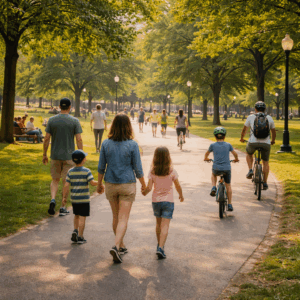
Parks host some of the most dynamic activity in a city. Families, seniors, children, runners, cyclists, events, and maintenance crews all use the same spaces, often at the same time. Add changing weather, seasonal patterns, and large public gatherings, and parks quickly become complex environments to manage.
From a safety perspective, parks are frontline spaces. Crowd surges, trail congestion, lighting issues, and delayed response to incidents can quickly affect public confidence. Unlike other infrastructure, park safety is experienced directly by residents, not through reports or dashboards.
From a health perspective, parks support physical activity, mental wellbeing, and social connection. The National Recreation and Park Association consistently highlights how access to safe, well-maintained parks is linked to better community health outcomes (https://www.nrpa.org/our-work/Three-Pillars/).
From a climate perspective, parks act as buffers. They absorb heat, manage stormwater, and provide relief during extreme weather. During heat waves, parks can be lifelines. During heavy rainfall, they often reveal early signs of drainage stress long before streets flood.
Why Parks React Faster Than Other Systems
What makes parks especially sensitive is how quickly conditions change.
A trail that is calm in the morning can be overcrowded by mid-afternoon.
A light drizzle can turn pathways muddy and unsafe within minutes.
A community event can double foot traffic without warning.
Unlike utilities or transport systems, parks do not have rigid operating hours or controlled access. Their openness is their strength, but it also means city teams have less margin for delay.
This is why parks often become the first place where larger urban issues surface. Crowding reveals mobility gaps. Drainage issues hint at climate stress. Maintenance backlogs show up as safety complaints. Parks feel these shifts early.
The Operational Challenge for Recreation Leaders
Parks and recreation leaders understand this reality well. They balance programming, maintenance, safety, and community expectations, often with limited resources. What makes the job harder is that many signals arrive too late or in fragmented ways.
Usage data lives in one place.
Maintenance reports in another.
Weather alerts somewhere else.
By the time information is stitched together, the moment to act has often passed.
This challenge is not about effort or intent. It is about timing and coordination. Recreation teams need awareness while conditions are forming, not after complaints arrive.
Parks as Early Warning Systems
Increasingly, cities are beginning to recognize parks as early indicators of broader urban health.
When trails become congested, it points to mobility pressure.
When air quality shifts in green spaces, it reflects environmental stress.
When certain parks see repeated safety issues, it highlights inequities in access and upkeep.
Treating parks as sensitive infrastructure means listening to these signals early and responding before problems escalate.
The U.S. Environmental Protection Agency has noted the growing role of green infrastructure in climate resilience and public safety planning (https://www.epa.gov/green-infrastructure/green-infrastructure-benefits). Parks are not separate from city systems. They are deeply connected to them.
Where the Conversation Is Heading
These shifts are no longer theoretical. They are actively being discussed by parks and recreation leaders across the country.
This February, many of these conversations will continue at the North Carolina Parks and Recreation Directors Conference in Raleigh (https://rrs.cnr.ncsu.edu/professional-development/ncprdc/). For decades, the conference has brought together directors to share real-world challenges, practical insights, and evolving approaches to improving parks and recreation systems across North Carolina.
Varidx in the Ecosystem
This is where Varidx fits naturally into the picture.
Varidx works with cities and public agencies to help bring clarity to how public spaces are used and how conditions change in real time. By supporting better awareness across systems, Varidx helps parks and recreation teams act earlier, coordinate better, and respond with confidence.
The goal is not to turn parks into technical environments. It is to preserve what makes them human, while giving city teams the insight they need to protect them.
Why This Matters Now
As cities face more extreme weather, higher usage of public spaces, and growing expectations for safety and accessibility, parks will only become more critical.
They are where people gather during good times and where stress shows first during challenging ones. Treating parks as sensitive infrastructure acknowledges their true role in city life.
Not just as green spaces, but as systems that support safety, health, climate resilience, and community trust.
Closing Thought
Cities are often judged by their biggest projects. But residents experience cities through everyday spaces.
Parks are among the most visible of those spaces. When they function well, people feel it immediately. When they don’t, trust erodes just as quickly.
Recognizing parks as sensitive infrastructure is not a technical shift. It is a mindset shift. One that places people, timing, and care at the center of urban operations.
And that shift is already underway.