
At Varidx, we believe internships should go beyond observation — they should let students roll up their sleeves, solve real challenges, and help shape practical outcomes. We encourage our interns to put their skills into action and see the difference they can make. This past summer, our internship program welcomed Achyuta Anandakrishnan, an Electrical and Computer Engineering student from NC State University (https://www.ncsu.edu/), who exemplified that mission.

During his time with Varidx, under the mentorship of our senior engineers, Achyuta worked on two high-impact projects that combined IoT, computer vision, and embedded systems to tackle everyday challenges in urban mobility:
- A Smart Bus Stop People Counter to help cities optimize public transit routes.
- A Parking Lot Occupancy Monitor to make finding parking faster and less stressful.
Both projects showcased how the next generation of engineers can help shape smarter, more connected cities.
Project 1: Smart Bus Stop People Counter
Public transportation works best when it runs on real demand. At Varidx, our vision-based people counter for bus stops was already developed and successfully demoed at an event with SELS. When Achyuta joined the team, his focus was on strengthening and refining the system to make it field-ready.
His Contributions:
- Integrated a PIR sensor and 4G LTE HAT for independent connectivity and better reliability.
- Studied heating issues in the Raspberry Pi and implemented a cooling fan to ensure stable performance.
- Conducted extensive testing in collaboration with SELS at the TPS site to validate performance in real-world conditions.
The Outcome:
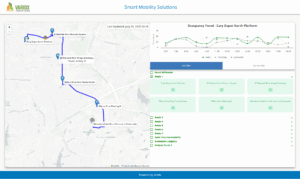
These refinements made the people counter more robust and deployment-ready, giving transit agencies reliable tools to view live passenger counts and adjust schedules accordingly — reducing wait times and improving the passenger experience. (https://app.varidx.io/smartmobility/)
Project 2: Parking Lot Occupancy Monitor
Parking availability is one of the most common frustrations for drivers. For his second project, Achyuta designed a vision-based parking occupancy system that detects whether each parking stall is occupied or free — all in real time.
The Result:
A system that processes live RTSP video feeds, detects cars using YOLOv8, and delivers updates through webhooks whenever a parking stall changes status. This technology enables parking operators (and potentially drivers) to know spot availability instantly, saving time and reducing congestion.
How It Was Built:
- Developed a stall-level detection system with polygonal boundaries for precise tracking.
- Validated accuracy using test images and videos before integrating with live camera streams.
- Added logic to smooth detection flicker, ensuring accurate, trustworthy results.
- Designed for headless operation and automatic recovery to keep systems running reliably.
The Value of Hands-On Learning
This internship was not just about building technology — it was about bringing ideas from concept to deployment. Achyuta gained valuable experience in:
- End-to-end IoT system design, from hardware integration to cloud analytics.
- Practical computer vision applications in real-world environments.
- Designing systems with resilience, accuracy, and scalability in mind.
For Varidx, the internship program reaffirmed the importance of investing in young engineers who bring fresh perspectives and creativity. For communities, projects like these demonstrate how IoT and AI can reduce wait times at bus stops, ease the stress of parking, and improve the overall urban experience.
Looking Ahead
At Varidx, we’re proud to provide students from top institutions like NC State University with opportunities to contribute to meaningful work. Interns like Achyuta remind us that innovation is a team effort — and that the future of smarter cities lies in the hands of the next generation of engineers.
We look forward to expanding our internship program and continuing to bridge the gap between academia and real-world impact.