
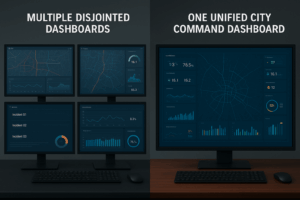
In many U.S. cities, government agencies run dozens of dashboards: traffic monitoring, water system status, public safety alerts, utility usage, etc. Each works well on its own. But when they don’t talk to each other, inefficiencies emerge. Disparate dashboards create blind spots. Decision-makers waste time jumping between systems. Emergencies that span multiple domains (like a storm affecting power, traffic signals, and public safety) can be especially hard to handle.
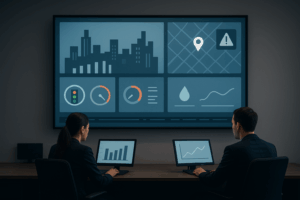
That’s where integrated command centers come in. They pull all those data streams into one centralized “nerve center.” Instead of having 5 or 10 separate tools, you get one interface that shows what’s happening across the city—traffic flow, water leaks, utility disruptions, emergencies, even weather updates. It speeds up response times, reduces redundant work, and lets city leaders see patterns they otherwise miss.
The Case for Integration: Efficiency, Cost, & Public Good
Cities that move to integrated platforms often report big gains. For example, with unified systems, the cost of maintaining multiple dashboards drops (fewer software licenses, less overlapping maintenance, fewer “stitching” jobs where one system has to feed into another manually). Also, the ability to predict trouble—e.g. stress on utilities, potential traffic jams, public safety threats—increases, so you shift from reacting to planning ahead. That improves resilience, especially during extreme events (storms, floods, heat waves) which are becoming more frequent. Using predictive analytics with unified data can help reduce operational costs by double digits in many cases.
On top of that, citizens benefit. Quicker responses, more reliable services, fewer interruptions. When all departments share a single dashboard, things like outage recovery, emergency coordination, or even traffic signal failures can be addressed holistically. Public trust tends to improve when people see their city government acting with speed and clarity—less finger-pointing between departments, more visible results.
What U.S. Cities Are Doing
Let’s look at some U.S. examples. While full “integrated command centers” are still emerging in many places, there are concrete projects and pilots showing how this is working out.
- Fort Benning, Georgia – The Smart Installation and Community Dashboard (SICD) was developed in 2021-2023 under US Ignite. It consolidates IoT sensors, weather data, and operational metrics to give commanders better situational awareness. One impact: heat stress monitoring (WBGT sensors) was centralized, reducing duplication of effort across units. US Ignite
- Minneapolis, Minnesota – The city has its Intelligent Operations Center, built with IBM. From 2023-2025, Minneapolis has expanded this center’s role, tracking over 1,200 key performance indicators tied to city goals. That includes pavement condition, stormwater maintenance, snow removal, traffic safety, etc. This gives city officials a way to measure performance, hold departments accountable, and spot where things are falling behind. German Marshall Fund
Other U.S. smart city projects (though not always full command centers) are moving in this direction. For example, Dallas, Texas, has been combining air quality sensors, traffic monitoring, and public WiFi to address crime and connectivity together, instead of in silos. cocoflo.com

How Varidx Fits the Vision
Varidx’s Smart City Platform is built to align with this integrated-command-center model. varidx.io A few ways it does so:
- Unified Dashboard: Varidx pulls in data from IoT sensors, cameras, weatherfeeds, public safety alerts, parks, transportation, utilities—all into one dashboard.
- Data-Agnostic, Flexible: Because it works with many types of sensors and external feeds, cities aren’t locked into one vendor for each domain. That flexibility cuts down on cost and simplifies scaling.
- Focus on Smaller Cities Too: Varidx emphasizes providing “smart city” benefits at a price that small and midsize cities can afford. So even when you don’t have a huge budget, an integrated platform still makes sense and is accessible.
By offering centralized control, real-time monitoring, and analytic insights, Varidx gives cities something very close to “one brain” for operations—without needing each department to reinvent its own dashboard.
Key Challenges and How to Overcome Them
Implementing an integrated command center isn’t trivial. Cities face technical, organizational, and political hurdles:
- Data Integration & Interoperability: Different departments often use different systems (software, data formats, sensors). Pulling them into a unified platform requires standardization, APIs, and sometimes retrofitting legacy systems.
- Costs and Budgeting: Even though integration saves money long term, the upfront investment (software, sensors, staff training) can be large. Getting buy-in from stakeholders and showing clear ROI helps.
- Data Privacy & Governance: More data integration means more risk. Cities need strong privacy protections, transparency in how data is used, and ways to ensure data accuracy and security.
- Change Management: Departments used to working independently may resist centralized dashboards. Operations, roles, and responsibilities may need to shift. Training and stakeholder engagement are critical.
Varidx’s platform helps mitigate these: its flexibility in integrating different sensors/data sources reduces retrofits; the dashboard approach helps with visibility (which aids in getting stakeholder buy-in); and real-time alerts + resource optimization provide measurable ROI to justify the cost.
The Road Ahead
Cities in the U.S. should consider the following steps to move toward integrated command centers:
- Start with a pilot: pick a few departments (e.g. traffic + public safety), integrate their dashboards, prove the value.
- Build on standards: choose systems and vendors that support open APIs and data interoperability.
- Plan for scalability: ensure the platform can grow (more sensors, more data streams).
- Engage the community: transparency helps build trust; show citizens how the system improves response times, reduces outages, etc.
With climate pressures, aging infrastructure, and growing urban populations, the need for streamlined operations has never been sharper. An integrated command center isn’t just a nice-to-have. It’s a foundation for more responsive, resilient, and cost-efficient city government.
Conclusion
In short, dashboards in silos aren’t enough anymore. U.S. cities are increasingly moving toward unified command centers—platforms that let city leaders see, act, and plan from one place. Varidx offers tools that match this vision: data-rich, flexible, cost-sensitive, and built for real operations. The payoff is efficiency, quicker responses, better service, and ultimately, cities that serve people more reliably.