

When people imagine “AI in cities,” the picture usually looks futuristic, robots guiding traffic, drones dropping off groceries, self-driving everything.
It is a fun image. It is also nowhere close to what citizens actually interact with each day.
The real work of AI in cities is quieter, simpler, and far more grounded in daily life.
It shows up in the moments between home and office, in the way traffic moves on your street, in how long you wait for a bus, and even in how clean your neighborhood stays.
AI is not here to make cities look futuristic.
It is here to make cities feel easier.
And that subtle shift is where the true transformation is happening.
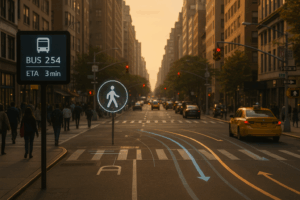
Smarter Cities Start With Small Wins
For most people, “smart city technology” becomes real only when it solves a basic inconvenience. Not a headline-worthy one—just something that makes their day a little smoother.
Here are the kinds of small improvements AI is quietly powering:
1. Bus arrival times that mirror reality—not guesses
In many cities, traditional bus schedules don’t survive real-world conditions: traffic jams, road closures, long boarding lines.
AI changes that by learning from patterns across thousands of trips. It updates arrival predictions in real time, adjusting minute-by-minute as traffic builds, weather shifts, or ridership spikes.
The result?
People stop wasting time waiting at a bus stop. They time their commute better. They trust the system more.
This may sound small, but for someone catching a bus at 7 AM, it means everything.
2. Crosswalks that actually protect pedestrians
AI-powered crosswalk systems can detect when someone is waiting to cross, how crowded the intersection is, or when a distracted pedestrian steps into the road.
Instead of relying only on fixed timers, signals adapt to what is happening in real time.
It is not futuristic.
It is simply safer.
A senior citizen gets more time to cross.
A child rushing for school gets a few extra seconds of protection.
Drivers receive clearer cues to slow down.
That kind of safety upgrade never makes news, but it changes how cities feel.
3. Cleaner streets through smarter waste pickup
Most cities schedule garbage collection by fixed routes and fixed days.
But some streets fill up faster than others. Long weekends create extra waste. Festive seasons change patterns entirely.
AI helps sanitation teams map actual usage and demand.
Instead of trucks driving the same route regardless of how full bins are, they go exactly where they are needed.
The benefits stack up fast:
- cleaner neighborhoods
- quieter mornings
- fewer overflowing bins
- less fuel used
- lower municipal costs
Small changes for a cleaner, calmer city.
4. Traffic signals that adapt, not frustrate
You know that feeling—sitting at a red light when no one is crossing.
Or crawling through an intersection because the light turns green for only a handful of cars.
AI-controlled signals understand the flow of traffic, not just the clock on the pole.
They stretch green lights when traffic builds. They shorten them when the road clears. They coordinate signals across long corridors to prevent bottlenecks.
The impact is instant—shorter commutes, smoother intersections, fewer unnecessary stops.
Again, no robots. No sci-fi. Just better timing.
AI Is Becoming the City’s Invisible Helper
The best part about AI in cities is that you often don’t notice it working.
You simply feel that things:
- move a little faster
- run a little smoother
- waste a little less time
- cause a little less stress
AI reduces friction in the small moments that make up a day.
It does not need a billboard.
It does not need a shiny gadget.
It just needs good data and a city willing to use it well.
Why These Small Fixes Matter
When enough small, everyday improvements stack up, they reshape how people see their city.
Citizens feel that the city “works.”
They feel heard without needing to shout.
They feel the system improving without seeing giant construction projects.
This is the kind of progress that builds trust.
And trust is what smart cities are built on.

Where Varidx Fits In
Behind these small wins is something simple yet powerful—connected, real-world data.
Better bus predictions, crosswalk alerts, adaptive signals, smarter waste pickup—none of this happens without clean data feeding the right AI models.
Varidx builds exactly those intelligence layers.
Their platform gathers data from sensors, mobility systems, public safety networks, city operations teams, and environmental monitors.
It connects the dots so cities can see what is happening and act in the moment.
And when that intelligence flows into the everyday systems people rely on, cities become more human, not more robotic.
Small Shifts. Big Difference. Smarter Future.
If there’s one message cities should take forward, it is this:
You don’t need flashy tech to become a smart city.
You need clarity. You need connected data. And you need AI that solves real problems—not imaginary ones.
In fact, these everyday improvements are shaping the future of smart cities across the country.
And that brings us to the next step.
This December, leaders, planners, technologists, and innovators are coming together to explore how AI is being used in real, practical ways across American communities.
It is a chance to see how these small shifts scale into big, citywide impacts.
If you are building, designing, or even just curious about the next chapter of urban life, this conversation is worth joining.
Register for the event here:
AI for Smart Cities: Innovation, Intelligence, Impact. Shaping the Future Together – Fill out form